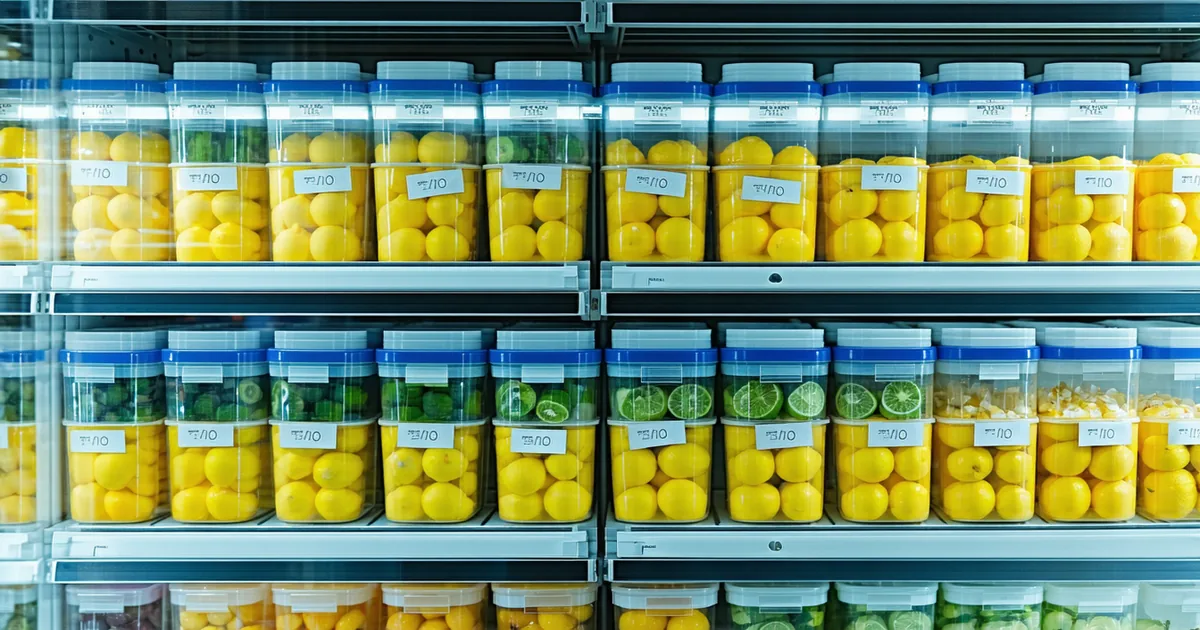
FIFO — first in, first out — is one of those BoH principles that looks obvious on paper and then quietly falls apart the moment a Saturday prep crew is moving at speed. The walk-in refrigerator hits 80% capacity. A delivery arrives during the lunch rush. The pantry cook grabs the nearest container, not the oldest one. Three days later, a 4-pound batch of prepped tomato concasse gets thrown because nobody dated it. Multiply that across a chain with eight locations and a rotating staff roster, and the walk-in becomes a slow leak in your food cost.
Understanding why FIFO breaks down at scale — and what it actually takes to enforce it — requires being honest about the gap between training and execution.
The Labeling Problem Is Bigger Than You Think
Most BoH managers will tell you their team labels everything. Ask them to pull a random container from the walk-in mid-service, and the story often changes. Labels fall off. Handwriting is illegible. Prep date and use-by date are used interchangeably by different staff members. A 6-ounce portion of trimmed chicken breast stored Sunday evening sits behind a batch prepped Monday morning because it was pushed to the back when space got tight.
The structural issue is that labeling is treated as a one-time action rather than a position-dependent practice. In a single-unit kitchen with a tenured crew, informal norms fill the gaps — the AM prep cook knows that yesterday's mirepoix is on the second shelf, left side. In a growing chain with 25–40% annual hourly staff turnover, those informal norms don't transfer. New hires haven't built the mental map. The walk-in is just a walk-in.
A Northeast Italian-American chain we know of — 10 units at the time, each running 180–220 covers on weekends — found that nearly 30% of prep containers in their walk-ins lacked a legible prep date after surveying across three locations on a single Thursday. No one had been deliberately skipping dates; the label tape had run out, the Sharpies were dried out, and during a Friday prep rush nobody stopped to replace them. This is a systems problem, not a training problem.
FIFO vs. FEFO: Knowing Which Rule You Actually Need
The restaurant industry defaults to FIFO — oldest stock gets used first, based on when it entered inventory. That works cleanly for dry goods with identical shelf lives: the case of panko breadcrumbs received Tuesday goes in front of last Friday's case. Simple.
But prepared foods and fresh proteins often require FEFO — first expired, first out — rather than strict date-of-receipt ordering. A batch of house-made Caesar dressing has a 4-day refrigerated shelf life. If you receive a new batch mid-week, strict FIFO by receipt date could still push you to use a newer batch before an older one that's expiring sooner. The prep date is what matters for TCS (time/temperature control for safety) foods, not the delivery date.
We're not saying FIFO is the wrong framework — for most packaged and dry SKUs, it remains the right default. The point is that a blanket "FIFO everything" policy applied to house-made preps, cut produce, and portioned proteins will occasionally produce the wrong result. Your rotation policy needs to distinguish between SKUs with fixed vendor-printed expiration dates and prep items where your kitchen sets the use-by based on preparation time.
Walk-In Zoning as a Physical Enforcement Mechanism
Signage and training alone have a ceiling. The most durable FIFO enforcement happens when the physical layout of the walk-in makes the right behavior easier than the wrong behavior.
Dedicated shelf zones by category — raw proteins bottom-left, prepped proteins bottom-right, dairy upper-left, produce bins mid-level — reduce the chance that a new prep cook puts marinated chicken next to the pickled onions or that the sauté cook grabs from the wrong shelf in dim walk-in lighting. When each category has a fixed home, stock rotation within that zone becomes a mechanical act: newer batch goes behind the existing stock.
The receiving dock workflow matters equally. If the receiving staff brings in a produce delivery and the walk-in is full, the path of least resistance is to stack new deliveries at the front. Dedicated "incoming" staging shelves — ideally labeled and emptied at each AM prep — create a temporary zone where new stock waits to be properly positioned behind existing inventory. It adds 90 seconds to the receiving process and removes a consistently recurring FIFO failure point.
Color-coded container lids by day-of-week work well in high-volume kitchens. Monday's prep goes in yellow-lidded containers, Tuesday's in green, and so on. The lid color tells the expo or grill cook at a glance whether they're reaching for Monday or Thursday's batch without reading a label. In a 300-cover service, that friction reduction is meaningful.
Where Scale Specifically Breaks FIFO Down
Single-unit operators can walk their walk-in daily and catch problems. Multi-unit operators cannot. When an operations director is overseeing six or more locations, the walk-in at Unit 4 gets physically inspected once every week or two. In between, FIFO discipline is entirely dependent on the store-level KM and prep crew.
The accountability gap widens at specific pinch points:
Par-level over-prep. When par levels are set too high — or not updated seasonally — kitchens regularly over-prep. A sauté station set to maintain a 3-quart par of house-made bolognese during the summer may have been appropriate in December when that item was running at 40 covers per night. By July, the item is selling 12 portions. The surplus doesn't get thrown immediately; it gets rotated "FIFO-style" until it's past use-by, at which point it becomes a write-off. The rotation practice was correct; the par level caused the problem.
Menu 86 situations. When an item gets 86'd mid-service — typically because prep ran out — the receiving cook may have actually prepped ahead but placed the newer batch in front during a chaotic afternoon. 86'ing an item that physically exists in the walk-in is a pure FIFO failure with real revenue impact: a guest gets told "we're out of the grilled salmon" while 8 portions of prepped salmon sit behind last night's batch, slightly past ideal service temp because nobody pulled them correctly.
Shared walk-ins. High-volume kitchens where the day-part crews share a single walk-in compound all of these issues. The AM prep crew stocks for lunch; the PM prep crew adds dinner preps. Neither crew necessarily knows the full inventory state of the other's section. Without a logged inventory handoff — even a simple one — stock rotation becomes a guessing game.
Closing the Loop: Inventory Counts Tied to Rotation
FIFO enforcement without accountability cycles is an incomplete system. Scheduled, routine prep inventory counts — even informal shelf scans by the opening KM — catch rotation failures before they become disposal events. The goal isn't to build a forensic paper trail for every prepped item. The goal is to make rotation failures visible quickly enough to act on them.
When par levels, prep dates, and on-hand quantities are tracked consistently, patterns emerge. If Unit 3 is consistently writing off 2–3 pounds of prepped protein per week, the root cause is identifiable: either the prep par is wrong, the rotation practice is failing, or portion sizes are inconsistent. Without the count data, all three root causes look identical at the P&L line — they all show up as food cost variance.
For growing chains specifically, building that habit at units 3 and 4 is much easier than retrofitting it at units 12 and 13. The systems you're willing to document and enforce at scale are the ones that need to be established while the team is still small enough to course-correct quickly.