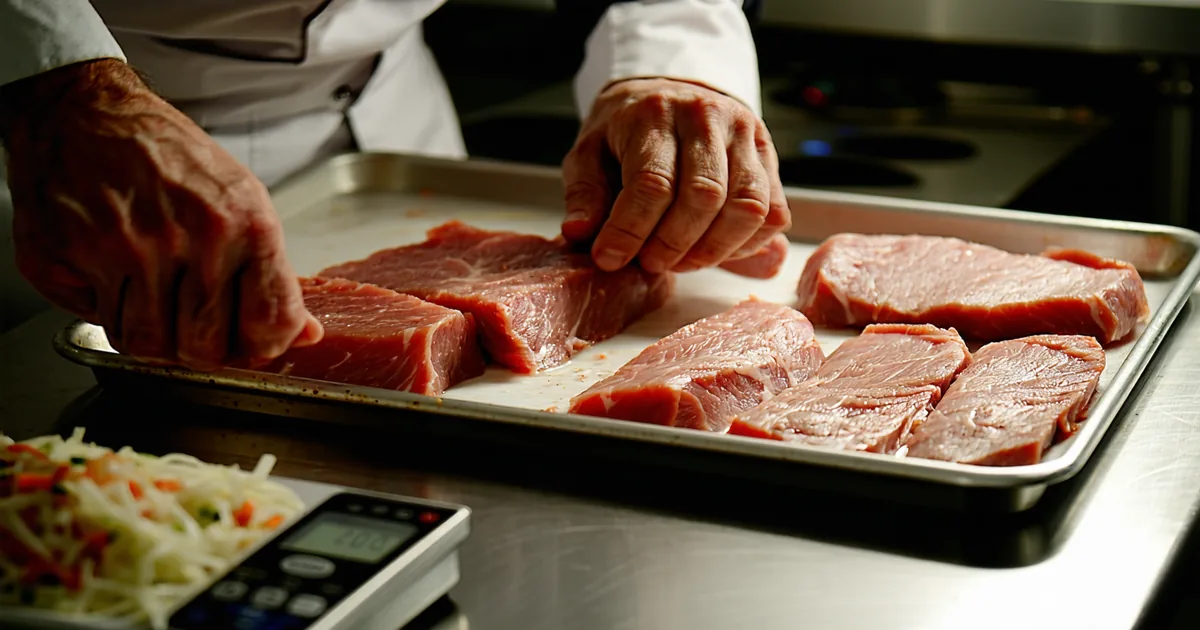
Theoretical food cost is a calculation. Actual food cost is a measurement. The difference between them — food cost variance — is a diagnostic, and what it tells you depends entirely on how rigorously you've built each of the two numbers it compares. Most operators who find their actual running above theoretical by 2–4 points assume the problem is theft or portion size. Sometimes it is. More often, the gap is yield variance on the prep line, and it's been there long enough to be accepted as normal.
How Theoretical Food Cost Gets Built (and Where It Breaks)
Theoretical food cost models what your food cost should have been if every recipe was executed to spec, every ingredient was purchased at the cost in your system, and every unit was sold as plated. The formula is simple: sum of (portions sold × recipe cost per portion) divided by food revenue, expressed as a percentage. If your recipe says an 8-ounce salmon portion costs $4.60 at current weighted-average cost (WAC) and you sold 340 portions, your theoretical contribution from that item is $1,564.
The weakness of theoretical food cost is that it's only as accurate as the recipe costs underlying it. Recipe costs depend on yield factors, on current purchase prices, and on whether the recipe itself reflects what's actually being plated. A salmon dish that gets a garnish change mid-season without a recipe update is now costing more than the theoretical says. A protein whose WAC shifted upward 12% when the last invoice processed hasn't been reflected in theoretical until someone updates the system. Neither of these failures shows up until you close the period and compare actual to theoretical.
Where Yield Variance Lives on the Prep Line
Yield variance is the gap between the yield your recipe assumes and the yield your team is actually getting. It shows up in three places: receiving, butchery and trim, and cooking loss.
Receiving. If a recipe yield is built on the assumption that incoming salmon arrives at a consistent trim-ready quality and the actual fish requires additional trimming due to quality variation, the edible yield drops. A recipe assuming 88% yield from whole salmon filet delivering actual yield of 82% produces a 6-point yield shortfall on every pound received. At $11.40/lb (a plausible industry range for fresh Atlantic salmon), that's roughly $0.68 of unaccounted cost per pound — absorbed into the "actual" food cost as unexplained variance.
Butchery and trim. Protein trim is where yield variance accumulates most visibly. A 12-unit American-casual chain tracking butchery yield on beef tenderloin across their locations found a range of 68–76% usable yield from the same UoM SKU across their six highest-volume stores. The difference came down to who was doing the trim and how consistently the butchery standard was being followed. At a WAC of $19.80/lb for tenderloin, the 8-point yield spread translated to roughly $1.58 of cost difference per pound between best-performing and worst-performing locations — before any other variance source.
Cooking loss. Braised and roasted proteins lose moisture during cooking. A recipe built on a 72% cooking yield from braised short rib will produce different results if the cook time, temperature, and braising liquid ratio vary by prep shift. A yield deviation of 5% on a high-volume braise item — say, a menu staple running 60 portions per day — compounds quickly against theoretical.
We're not saying that yield variance is always the primary driver of food cost overrun. Theft, over-portioning, waste from over-prep, and incorrect pricing in the recipe cost system all contribute. The point is that yield variance is frequently underweighted in variance investigations because it's harder to see than a portioning discrepancy — and because many kitchens don't measure yield at all, they infer it from what they were taught to expect.
Shrinkage vs. Waste: A Distinction That Matters
Shrinkage and waste are often used interchangeably in BoH conversations, but they drive different corrective actions. Shrinkage refers to volumetric or weight loss that is inherent in the cooking or handling process — the moisture lost in roasting, the trim removed during butchery, the reduction in a sauce base. Properly accounted-for shrinkage is baked into the theoretical food cost through yield factors. If shrinkage is causing variance, it means your actual yield is worse than your assumed yield — the problem is in the recipe standard or the execution consistency.
Waste, by contrast, is inventory that was purchased and prepped but never sold: over-prep that gets thrown, product that spoils before it can be used, or prep errors that result in unusable product. Waste doesn't show up in theoretical food cost at all — theoretical assumes 100% of what you prep gets sold. When actual exceeds theoretical by a consistent margin and yield analysis rules out a measurement problem, waste is often the remainder.
Distinguishing the two requires separate tracking. Yield variance is identified through butchery tests and cooking yield audits. Waste is quantified through regular spoilage logs and waste tracking at the end of each prep cycle. Both require deliberate data collection; neither surfaces automatically from the P&L.
Running the Variance Analysis
A practical variance analysis for a BoH operator doesn't require a financial background. The workflow has four steps:
First, pull theoretical food cost from your recipe costing system for the period — ideally by category (proteins, dairy, produce, dry goods) rather than in aggregate. Category-level variance is more actionable than a single blended percentage.
Second, calculate actual food cost for the same period: opening inventory value plus purchases minus closing inventory value, divided by food revenue. If your inventory counts are accurate, this number is reliable. If inventory counts are estimated or skipped, actual food cost is fiction — and the variance analysis is comparing one reliable number against one unreliable one.
Third, compare theoretical to actual at the category level. A protein category running 3.2 points above theoretical while produce and dairy are within 0.5 points is a specific signal. It narrows the investigation to butchery yield, cooking loss, or protein-specific waste before you've looked at a single invoice or walked a single station.
Fourth, run targeted yield tests on the protein category's highest-volume items. Weigh raw product on receipt, weigh again after trim, weigh the finished portion. Compare against the recipe yield assumption. The first time you run this test, expect surprises.
The Multi-Unit Dimension
Food cost variance analysis at the chain level adds a layer that single-unit operators don't face: cross-location comparison. When the same menu item runs theoretical food cost of $3.40/portion across all units but actual per-portion cost varies between $3.20 at Unit 1 and $4.05 at Unit 5, the gap is location-specific and almost always traceable to prep execution, not purchasing prices. Purchasing is typically centralized; prep is local.
That cross-location signal is one of the most useful outputs of a disciplined variance analysis process. It identifies where execution training is needed, which KMs are running tight prep disciplines, and where par-level or yield assumptions need to be revisited for specific locations. Without it, food cost management at the chain level defaults to applying chain-wide averages to location-specific problems — which mostly means the problem stays unresolved while the average hides it.