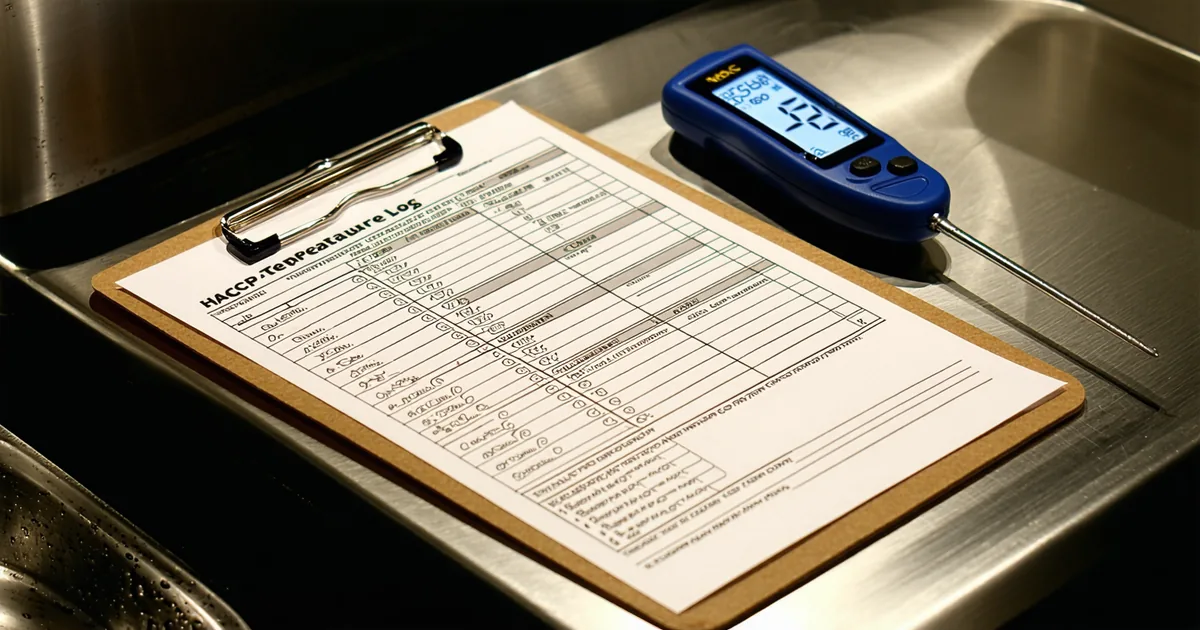
Every HACCP plan has critical control points. Every CCP has a defined critical limit — a temperature threshold that, if not maintained, creates a food safety hazard. And every HACCP plan requires documented monitoring records that prove those limits were checked and met. In most restaurant kitchens today, that documentation still happens on paper. A clipboard on the walk-in door. A pre-printed grid with boxes for AM and PM cold holding checks. A handwritten number, sometimes in pencil, sometimes smudged, sometimes missing entirely because the closer was slammed and forgot.
Paper temperature logs are not inherently incompetent. They are structurally vulnerable in ways that digital records are not, and the consequences of that vulnerability accumulate quietly until an inspection surfaces them all at once.
What HACCP Actually Requires from Your Records
A HACCP plan is built around identifying biological, chemical, and physical hazards, establishing CCPs where control is critical, and defining monitoring procedures with corrective actions for each. The records requirement exists because HACCP is a preventive system — documentation is how you demonstrate that the plan was executed, not just written.
For temperature-sensitive TCS foods, the standard monitoring checkpoints are well-established in practice: cold holding at or below 41°F, hot holding at or above 135°F, cooked poultry at 165°F internal, whole-muscle beef at 145°F minimum, and the cooling requirement that moves cooked food from 135°F to 70°F within 2 hours and from 70°F to 41°F within an additional 4 hours. Dishwasher final rinse temperature, per NSF standards, should reach 180°F at the dish surface for high-temperature machines. These are the checkpoints. The log is the proof that someone actually checked them.
A paper log with a missing entry is not a minor clerical gap. An inspector looking at a HACCP monitoring record with two blank cells on a Friday afternoon has no way to verify whether those checks were performed and not recorded, or were simply not performed. From a compliance standpoint, undocumented is indistinguishable from not done. That distinction matters enormously when a health department investigation follows a foodborne illness report.
How Paper Fails in Practice
The failure modes for paper temperature logs are so consistent they read like a checklist: faded or smudged ink (commercial kitchens are humid environments), illegible handwriting during busy shifts, logs stored in the wrong location and unavailable during inspection, entries made in bulk at the end of a shift ("pencil-whipping"), missing signatures, mismatched dates, and forms that are the wrong version after a menu or process change.
Consider a growing 6-unit fast-casual Mediterranean chain. During a surprise health inspection at their busiest location, the inspector asked for HACCP temperature logs covering the prior 30 days. The file produced had eight days with incomplete records and three days missing entirely — not because the checks hadn't been done, but because the closing team had been using a form that didn't have space for the new walk-in cooler added four months prior. Those checks were being recorded on a separate scrap sheet that nobody had filed consistently. The inspection resulted in a conditional pass with a 10-day corrective action deadline. The records failure was entirely procedural; the actual food safety practice had been sound. The documentation failure made it impossible to demonstrate that.
We're not saying paper logs are illegal or that kitchens using them are unsafe — thousands of independent and growing restaurant operations run compliant HACCP programs on paper. The argument is that paper creates specific, avoidable failure modes that have nothing to do with your team's commitment to food safety and everything to do with the nature of paper as a medium.
What Digital Records Actually Change
The core advantage of a digital temperature log is not the technology — it's the timestamp and the required-field enforcement. When a check is due, the prompt appears. When the reading is entered, it's stamped with the exact time and the employee ID. The field cannot be left blank without the system flagging it. The corrective action workflow, if a reading falls outside the CCP's critical limit, is part of the same record. The inspector doesn't need to cross-reference a separate corrective action binder.
For multi-unit operators, the operational shift is more significant than for single-unit owners. A chain HQ cannot physically verify that the temp log at each store was completed correctly — they're relying on what they can see remotely. Paper gives them nothing. A digital system with a centralized dashboard shows, by location, which checks are complete, which are overdue, and which have triggered corrective actions. An operations director reviewing morning compliance across 8 locations can do that in 90 seconds instead of waiting for scanned paper reports or store-level phone calls.
Out-of-range temperature events become particularly manageable when logged digitally. If a walk-in compressor issue causes the unit to drift to 44°F overnight, a digital system can surface that to both the store KM and the chain's food safety lead simultaneously — before service, before TCS foods have been at risk for an extended period. With paper, that same event might not surface until the AM crew opens the unit, discovers warm product, and has to make a judgment call under time pressure with no documented temperature history to inform the decision.
The Transition Complexity Is Real But Manageable
Operators who have built their inspection readiness around paper logs face a genuine transition cost. Staff who have been doing paper temp checks for years need to learn a new workflow. Bluetooth probe thermometers that sync directly to a tablet-based log are more reliable but have upfront hardware costs. Some platforms require WiFi coverage in the walk-in and dry storage areas where paper-based kitchens may have no infrastructure.
The practical path forward for most growing chains is not a big-bang cutover. Starting with the highest-risk CCPs — walk-in cold holding and hot hold station checks — allows teams to build the digital log habit on the most-checked items before expanding to cooling logs and receiving checks. Those two checkpoint categories are the most frequently audited and the most frequently problematic in paper-based programs, so the compliance benefit is immediate.
Training for digital temp logging should be structured around the corrective action workflow as much as the logging itself. The value of a digital system is not just the clean record — it's the moment when a reading comes in at 43°F and the cook knows exactly what to do next because the platform walks them through it, rather than consulting a laminated card they may or may not find.
Records as an Operational Asset, Not Just a Compliance Artifact
There is a narrower way to think about temperature logs — as compliance documentation, produced to satisfy inspectors. There is a more useful way: as operational data that tells you something about your equipment, your team, and your processes.
A consistent pattern of cold holding readings in the 38–40°F range during overnight hours that drift to 41–42°F between 11am and 2pm isn't a compliance failure — it's a signal that a walk-in may be struggling during peak door-open frequency, or that the thermostat is calibrated slightly warm. A pattern of hot hold readings near the 135°F floor at the grill station suggests that the heat lamp positioning or the holding pan setup may need adjustment before it becomes a CCP breach. These patterns exist in paper logs too, but they require manual review to spot. Digital records surface them without additional work.
Food safety records, done well, are not overhead. They're the continuous measurement layer that tells you whether your kitchen is operating within its own standards — and whether those standards are actually protective.