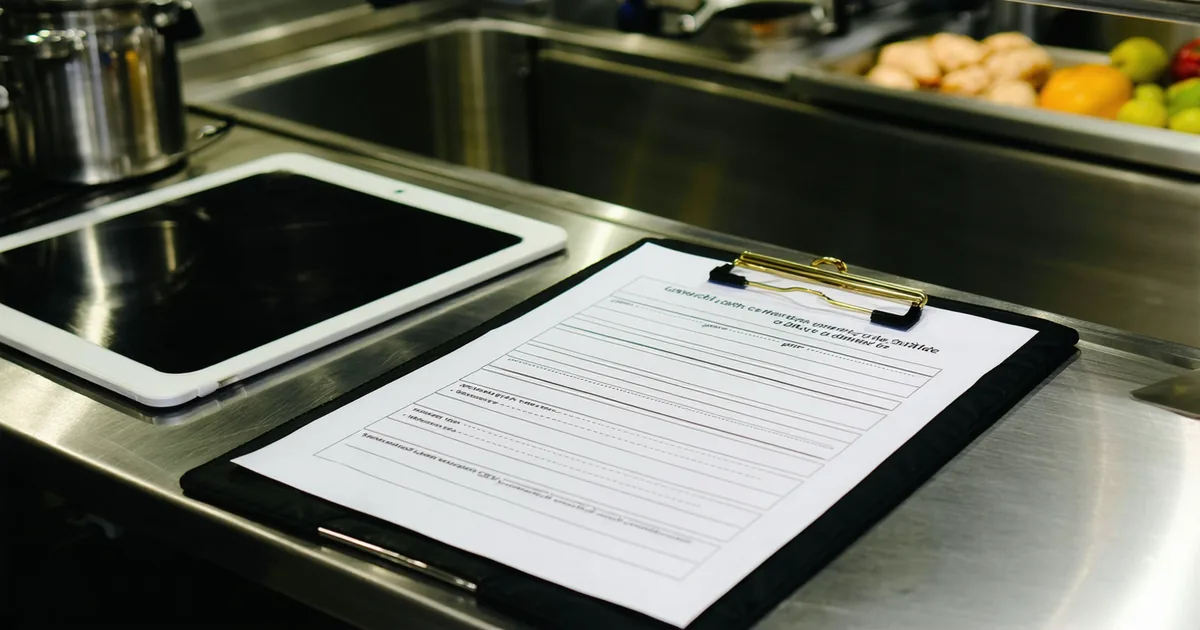
The morning line check is one of the most operationally important rituals in a restaurant kitchen and one of the most commonly abbreviated. At 10am, before the lunch rush, the opening KM walks the line: temperatures verified, mise en place confirmed, portions counted, par levels assessed. Done correctly, it takes 15–20 minutes and prevents an afternoon of scrambling. Done on paper, with a clipboard and a thermometer, it produces a record that lives in a binder, gets reviewed inconsistently, and tells the chain operator nothing they can act on until it's too late.
We worked through a scenario based on what a 5-unit casual dining group in the Mid-Atlantic typically experiences when transitioning from paper to digital line checks. The comparison is more instructive than the pitch.
What Paper Line Checks Actually Capture
A standard paper line check form covers three categories: temperature readings (cold hold stations, hot hold inserts, reach-ins), prep quantity on-hand versus par, and equipment status (burner function, oven temp calibration, ice bin levels). The KM walks each station with a probe thermometer, writes the readings, and signs off. The record goes in a binder.
The structural limitations of this format appear when you look at the data downstream. In a 5-unit group, paper line check binders at each location generate roughly 150 individual check records per week. No one reviews all of them. The chain HQ typically sees summary notes from the KM shift report, not the underlying temperature data. A cold-hold reading that was 43°F on Tuesday morning — technically above the 41°F maximum for TCS foods — might get a notation, or it might not, depending on whether the KM flagged it as a trend or dismissed it as a one-time blip on a warm day.
When issues compound across multiple locations, the paper system cannot surface the pattern. If three out of five locations are running their salad bars at 40–42°F on warm weather days, that's either a refrigeration maintenance issue affecting a specific equipment model or a cold hold practice gap — but you won't know it's a chain-wide pattern from five binders in five manager offices.
The Time Dimension: What Digital Changes About the 10am Check
Digital line checks alter the workflow in a specific way: the check generates a real-time record that's immediately visible to both the store and the chain operator level. The KM enters readings on a tablet, and every reading outside a defined threshold — say, any cold hold above 41°F or any hot hold below 135°F — flags immediately. The corrective action field appears on screen. The KM notes what they did (adjusted equipment, discarded product, retemped after adjustment). That record is closed-loop within the same interface.
In the 5-unit scenario, the shift to digital line checks produced a few specific operational changes after the first 30 days. First, the average time to complete the line check dropped from roughly 22 minutes per KM to 16 minutes — not because the check itself became less thorough, but because the structured digital form reduced the time spent on clipboard transcription and made the station routing more consistent. Second, the number of corrective action events that were formally documented increased by roughly 40% — not because more problems were occurring, but because paper checks had normalized skipping the corrective action documentation when the issue was minor ("just adjusted the dial, didn't write it up").
We're not saying paper line checks produce unsafe kitchens — plenty of independent restaurants with disciplined KMs have excellent food safety records on entirely paper-based systems. The argument is about the multi-unit accountability layer: at 5 or more locations, the chain operator needs a view of line check compliance and temperature trends that paper physically cannot deliver without significant manual aggregation effort.
Par Comparison During Line Check: The Hidden Value
Temperature checks are the visible part of the line check. The prep par comparison is often where the operational value is highest and where paper-based systems do the least.
A digital line check that includes prep par tracking lets the KM record on-hand quantities for key stations — grill, sauté, pantry — and compare them against the day's calculated par. If salmon portions on hand at 10am are at 18 when the dinner par calls for 32, the prep schedule for the next 4 hours is immediately obvious. If braised beef is already at 1.4× par, the sauté prep cook can shift to another task rather than building unnecessary inventory.
In the 5-unit scenario, before digital checks, an estimated 3–5 mid-service 86 situations per week per location were attributable to prep par gaps not identified at the morning check — either because the paper form didn't include par tracking or because the KM didn't have time to calculate the gap from handwritten counts. After digital checks with par integration, that number dropped toward 1–2 per location per week. The improvement was not dramatic, but across five locations it was meaningful: fewer 86 situations, fewer guest service failures, less PM prep pressure that drives over-prep and increases waste.
The Compliance Record Shift
For growing multi-unit operators, the compliance record value of digital line checks becomes significant as the operation matures. An operator managing 5 units today may have 12 or 15 in three years. The line check record structure built now either scales or it doesn't.
Paper binder records at 12 locations, inspected by a health authority, require the operator to aggregate and produce records location by location. A health department investigation asking for 90 days of temperature logs across a chain with paper records creates a significant retrieval burden. Digital records, archived centrally, are retrievable in minutes. The format is legible. The timestamps are not handwritten. The data does not depend on a manager's filing system.
For the BoH operator running 5 units now and planning for 10, the line check is one of those operational workflows where the system you build now determines the compliance posture you have at scale. Retrofitting digital record-keeping onto an established paper culture at 12 locations is harder than building it in at 5. The check itself — station temps, par comparison, equipment status — doesn't change. The medium it runs on determines how much information you actually have when you need it.
What the Numbers Don't Capture
The operational case for digital line checks is straightforward. What's worth acknowledging is what it doesn't fix. A digital form completed by a KM who doesn't actually walk the line — who enters approximate temperatures from memory or rounds readings — produces a clean digital record of inaccurate data. The accountability discipline required to make line checks meaningful is a training and culture issue, not a technology issue. Digital tools surface the result; they don't replace the underlying practice.
The KMs who run tight paper line checks will run tight digital line checks. The ones who treat the form as an administrative burden will find ways to shortcut either format. What digital does is make the shortcuts more visible: a pattern of readings that cluster suspiciously close to exactly 40.0°F across multiple checks looks different in a trend chart than it does across pages of a paper binder. The transparency cuts both ways — it surfaces problems faster, and it also surfaces the people who aren't taking the check seriously.
For growing chains, that visibility is the point.